

Quick Answer
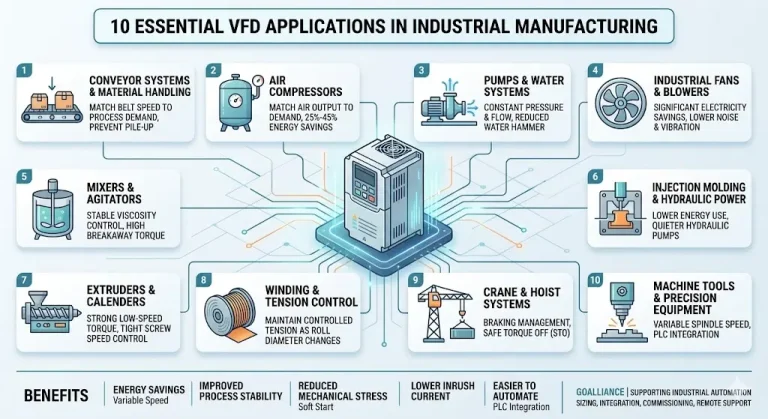
Variable frequency drives create the most value in manufacturing when the process needs variable speed,soft start,torque control,pressure control,tension control,or energy optimization.The most common high-value applications include conveyors,compressors,pumps,fans,mixers,extruders,winding lines,cranes,and selected machine-tool systems.
The right VFD does more than save energy—it improves process stability,reduces mechanical stress,lowers inrush current,and makes the entire production line easier to automate.
1.Conveyor Systems and Material Handling
Conveyors are one of the most common VFD applications in manufacturing and logistics.A drive allows operators to match belt speed to upstream and downstream process demand,preventing product pile-up,starvation,or unstable transfer conditions.
Soft start is equally important.Heavy-loaded conveyors can draw very high starting current under direct-on-line operation.A VFD limits inrush current and greatly reduces shock loads on couplings,gearboxes,chains,rollers,and belts.
2.Air Compressors
Compressed air is often one of the most expensive utilities in a factory.Variable-speed compressor control reduces unloaded running losses by matching air output to real demand.In plants with fluctuating demand,this can create 25%to 45%energy savings and improve system pressure stability at the same time.
3.Pumps and Water Systems
Process water pumps,cooling water pumps,booster pumps,wastewater lift pumps,and dosing systems all benefit from variable-speed control.Constant pressure and flow control are the most common objectives,but the operational value often goes further—smoother starts,reduced water hammer,lower pipe stress,and better integration with PLC logic.
4.Industrial Fans and Blowers
Fans and blowers are classic variable-torque loads.Dust collection systems,combustion air fans,ventilation systems,kiln fans,and exhaust blowers often produce some of the fastest and easiest VFD paybacks in a plant.
Because power drops sharply when speed is reduced,even modest modulation can generate significant electricity savings.In addition,lower speed means lower noise,less vibration,and longer bearing life.
5.Mixers and Agitators
Chemical,food,beverage,paint,and process manufacturing lines often require wide speed flexibility and high breakaway torque.A correctly selected VFD helps manage startup torque,forward/reverse sequences,recipe-based speed profiles,and stable operation across different viscosities.
6.Injection Molding and Hydraulic Power Units
Traditional molding machines often waste energy by running fixed-speed hydraulic pumps regardless of the process stage.VFD-based hydraulic pump control allows motor speed to follow actual demand during injection,holding,clamping,and cooling.The result is lower energy use,lower oil temperature,and quieter operation.
7.Extruders and Calenders
Plastic and rubber processing lines demand strong low-speed torque and stable speed control.Drives in these applications need robust vector control and careful tuning,especially when process stability depends on tight screw speed or roller synchronization.
8.Winding and Tension Control
Paper,film,foil,wire,cable,and textile lines depend on controlled tension as roll diameter changes.In these applications,the VFD is part of a larger control strategy involving dancer feedback,load cells,torque control,or encoder-based closed-loop speed regulation.
9.Crane and Hoist Systems
Lifting systems impose a more demanding duty cycle than standard industrial loads.Proper VFD selection for cranes and hoists often requires braking management,safe torque off,controlled deceleration,and in some cases regenerative solutions or active front-end technology.
10.Machine Tools and Precision Equipment
Not every machine tool uses a standard VFD,but many spindle and auxiliary systems still rely on variable-speed drive control.In these applications,response speed,power range,and integration with CNC or PLC controls matter as much as pure energy performance.
How to Choose the Right Manufacturing VFD
Start with the load type.Pumps and fans are variable-torque loads,while conveyors,mixers,hoists,extruders,and many process machines are constant-torque or heavy-duty loads.That distinction affects current sizing,overload requirements,and control mode selection.
Then check voltage,environmental protection,braking needs,communication protocol,and cable length.For factories using Profinet,Profibus,Modbus TCP,EtherNet/IP,or EtherCAT,communication compatibility should be confirmed at the beginning—not after the panel is built.
Where the Biggest ROI Usually Comes From
If your goal is quick payback,start with compressors,pumps,and fans.If your goal is process stability or throughput,start with conveyors,mixers,extrusion lines,or winding systems.If your goal is both,the best opportunities usually sit where energy waste and process variability overlap.
Frequently Asked Questions
Which manufacturing application saves the most energy with a VFD?
Compressed air,pumps,and industrial fans usually offer the strongest energy payback because they often run many hours under variable demand.
Which application needs the most careful engineering?
Cranes,hoists,extruders,winding systems,and precision motion applications typically require the most careful drive selection,tuning,and safety review.
Are all industrial motors good candidates for VFDs?
No.The load profile,control objective,cable length,motor insulation condition,and process requirements all need to be checked before specifying the drive.
Need Help Matching a VFD to Your Process?
Goalliance supports industrial manufacturing projects across multiple sectors,including logistics,water,HVAC,process industries,and general manufacturing.We provide drive sizing,panel integration,communication setup,commissioning,and remote technical support.
If you are planning a new automation line or upgrading an existing process,contact us for a project-based recommendation and engineering review.