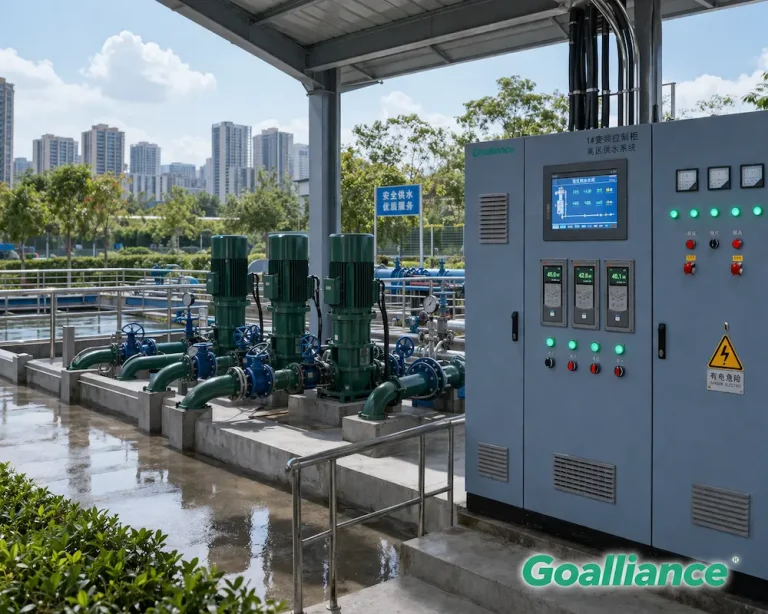


Project Background
A mid-sized agricultural cooperative in Yunnan Province,managing approximately 1,200 mu of mixed cultivation land covering rice paddies,vegetable greenhouses,and fruit orchards,had been operating its irrigation system using three fixed-speed centrifugal pumps driven by 37kW motors—a straightforward setup that had served the cooperative for over a decade but was increasingly creating problems as the cooperative expanded its operations and diversified its crops.
The fundamental issue was straightforward:different crops require different irrigation intensities at different times,but a fixed-speed pump delivers the same flow at the same pressure regardless of what the land actually needs at any given moment.Rice paddies during transplanting need high-volume flooding flow.Vegetable greenhouses need gentle,low-pressure drip-compatible supply.Orchards during dry season need sustained moderate flow over long periods.With fixed-speed pumps and no flow control other than manual gate valves,the cooperative’s irrigation workers were constantly opening and closing valves to manage flow to different sections—a time-consuming,imprecise,and wasteful process that still resulted in either over-irrigation in some areas or insufficient water delivery in others.
Solution
Goalliance proposed a practical,no-frills INOVANCE variable frequency drive solution sized and specified to match the cooperative’s actual operational requirements—not overengineered,not over-specified,and designed from the outset to be maintained by the cooperative’s own staff without specialist support for routine issues.

VFD Selection
Three INOVANCE MD290 series drives—one per pump,each rated at 37kW—were selected for this application.The MD290 was the right choice for a rural agricultural installation for several practical reasons beyond simply matching the motor rating.
The MD290’s built-in PID controller handles pressure regulation without requiring an external PLC or controller—reducing both equipment cost and the number of components that can potentially fail.Its simple keypad interface with Chinese-language display means the cooperative’s own staff can navigate fault codes,adjust pressure setpoints,and reset the system after a trip without calling an engineer.The drive’s wide input voltage tolerance of±15%is particularly relevant in rural Yunnan where grid voltage fluctuations are more pronounced than in urban industrial areas—the MD290 rides through these voltage variations without tripping,where more sensitive drives would fault out and require manual reset.Built-in motor overload and phase loss protection covers the most common failure modes in agricultural pump applications without requiring additional external protection relays.
Pressure Control and Zone Management
The system operates under constant pressure variable flow control using a single pressure transmitter at the pump station header.The target pressure setpoint can be adjusted by the operator from the HMI panel—set higher for full-field flooding irrigation during rice transplanting season,reduced for greenhouse drip supply,and further reduced for overnight orchard soaker irrigation where low flow over long duration is preferred over high-pressure delivery.
A simple irrigation timer function built into the control logic allows the cooperative to pre-schedule morning and evening irrigation cycles that start and stop automatically—eliminating the need for staff to be present at the pump station at 5:00 AM for early morning irrigation startup,a quality-of-life improvement that the cooperative’s chairman described as one of the most practically valuable outcomes of the entire project.
Results
- Overall irrigation pump system energy saving:41%versus fixed-speed baseline
- Number of pumps running simultaneously during typical irrigation periods reduced from 2–3 units to 1 unit for approximately 70%of operating hours
- System pressure stability improved—over-irrigation complaints from greenhouse operators eliminated within first growing season
- Irrigation worker time spent on manual valve adjustment reduced by approximately 3 hours per day
- Automatic timer scheduling eliminated need for early morning manual pump startup—staff quality of life improvement directly noted by cooperative management
- Compressor seal and mechanical seal replacement interval on pump units extended due to elimination of direct-on-line starting shock
- Full investment payback period:14 months—the shortest payback of any project in this case study series,driven by the high baseline energy waste of uncontrolled fixed-speed agricultural pumping
A Note on Project Scale
This project involved three 37kW pumps and a single control panel.It is one of the smallest projects Goalliance delivers.We include it here because the energy savings percentage,the payback period,and the operational improvements achieved are among the strongest in our project portfolio—and because we believe that small and mid-sized agricultural operators,cooperatives,and family farms deserve access to the same variable speed drive technology and engineering expertise that large industrial clients take for granted.
If your irrigation system is running on fixed-speed pumps and manual valves,the numbers in this case study are a realistic picture of what variable speed control can deliver for an operation your size.